


-
Home

-
Writing Services
- Reflective Journal Writing Service
Essay Writing & Research Paper Help | Prime Essays
Reflective Journal Writing Service: Professional Academic Reflection Support
A reflective journal is an important academic tool that allows students to examine their experiences, evaluate their learning, and connect theoretical knowledge with practical situations. Commonly used in nursing, social work, education, psychology, business, and other professional disciplines, reflective journals encourage critical thinking, self-awareness, and personal development. However, writing an effective reflection can be challenging, particularly when students must follow specific academic frameworks, demonstrate critical analysis, and support their observations with scholarly sources.
A reflective journal writing service provides academic assistance to students who need guidance in organizing their thoughts, developing meaningful reflections, improving academic expression, and following assignment requirements. At Prime-Essays.com, students can explore writing support designed to help them understand reflective writing, communicate their experiences clearly, and develop stronger academic reflection skills.
What Is a Reflective Journal?
A reflective journal is a structured written record in which students examine personal experiences, learning activities, professional encounters, or academic situations. Unlike conventional academic essays that primarily present arguments and research findings, reflective journals focus on the relationship between experience, knowledge, personal understanding, and future improvement.
Students are generally expected to describe an experience, consider their reactions, analyze what happened, and explain what they learned. They may also discuss how the experience relates to academic theories, professional standards, or practical skills.
For example, a nursing student may write about a clinical placement experience, examining communication with patients, teamwork, ethical considerations, and lessons learned. A social work student may reflect on an interaction with a client and evaluate the importance of professional boundaries, empathy, and effective communication.
A well-developed reflective journal should go beyond simply describing an event. It should demonstrate critical thinking and explain how the experience influences future practice.
Why Students Need a Reflective Journal Writing Service
Reflective assignments may appear straightforward because they involve personal experiences. However, producing a meaningful academic reflection requires more than describing what happened. Students must evaluate their experiences, connect them to relevant theories, and demonstrate an understanding of their personal and professional development.
A reflective journal writing service can provide guidance in several areas.
1. Organizing Personal Experiences
Students sometimes struggle to decide which experiences are relevant to their reflective assignments. Professional writing guidance can help them identify important events, organize observations, and develop a logical sequence of ideas.
2. Developing Critical Reflection
A strong reflective journal examines why an event occurred, what influenced the outcome, and what could have been done differently. Students can receive guidance on moving beyond description to deeper evaluation and analysis.
3. Connecting Theory with Practice
Many reflective assignments require students to apply academic concepts to real-life experiences. This may involve discussing communication theories, ethical principles, professional standards, leadership models, or evidence-based practice.
4. Improving Academic Writing
Reflective writing combines personal insight with academic language. Students may need help improving sentence structure, grammar, clarity, organization, and the appropriate use of academic references.
5. Following Assignment Guidelines
Universities often provide specific instructions regarding word count, reflective models, referencing styles, and assessment criteria. Academic assistance can help students interpret these requirements and organize their work accordingly.
Types of Reflective Journal Writing Services
Different academic disciplines use reflective journals for different purposes. Prime-Essays.com provides academic writing support across a range of reflective assignment types.
Nursing Reflective Journal Writing
Nursing students frequently complete reflective journals during clinical placements, laboratory sessions, and professional training. These assignments encourage students to examine patient interactions, communication, clinical decision-making, teamwork, and ethical responsibilities.
A nursing reflective journal may explore:
-
Patient communication and therapeutic relationships.
-
Clinical placement experiences.
-
Patient safety and professional accountability.
-
Ethical decision-making in nursing practice.
-
Teamwork and collaboration among healthcare professionals.
-
Application of evidence-based nursing practices.
-
Personal development and clinical learning.
Social Work Reflective Journals
Social work students use reflective writing to evaluate their experiences with individuals, families, communities, and professional environments.
Common topics include:
-
Client engagement and communication.
-
Professional boundaries and confidentiality.
-
Cultural awareness and inclusive practice.
-
Ethical dilemmas in social work.
-
Advocacy and social justice.
-
Empathy and professional self-awareness.
-
Evaluating intervention strategies.
Reflective writing helps students understand how personal assumptions, professional values, and theoretical knowledge influence their practice.
Education Reflective Journals
Education students and trainee teachers often prepare reflective journals to evaluate teaching experiences, classroom management, lesson planning, and student engagement.
Topics may include:
-
Classroom observation and teaching practice.
-
Student participation and learning outcomes.
-
Inclusive teaching strategies.
-
Classroom management challenges.
-
Teacher-student communication.
-
Professional development and teaching improvement.
Psychology Reflective Journals
Psychology students may reflect on their understanding of human behavior, research activities, group discussions, and practical learning experiences.
Assignments may involve examining personal assumptions, ethical responsibilities, psychological theories, and the relationship between academic concepts and everyday behavior.
Business and Management Reflective Journals
Business students use reflective journals to evaluate leadership experiences, teamwork, decision-making, workplace communication, and organizational behavior.
Common areas include:
-
Leadership and management development.
-
Group projects and collaboration.
-
Conflict resolution.
-
Workplace communication.
-
Business ethics and responsibility.
-
Problem-solving and decision-making.
Understanding Reflective Writing Models
Many universities recommend established reflective models to help students organize their assignments. Understanding these frameworks can make reflective writing more systematic and meaningful.
Gibbs' Reflective Cycle
A six-stage framework for examining experiences and planning improvements.
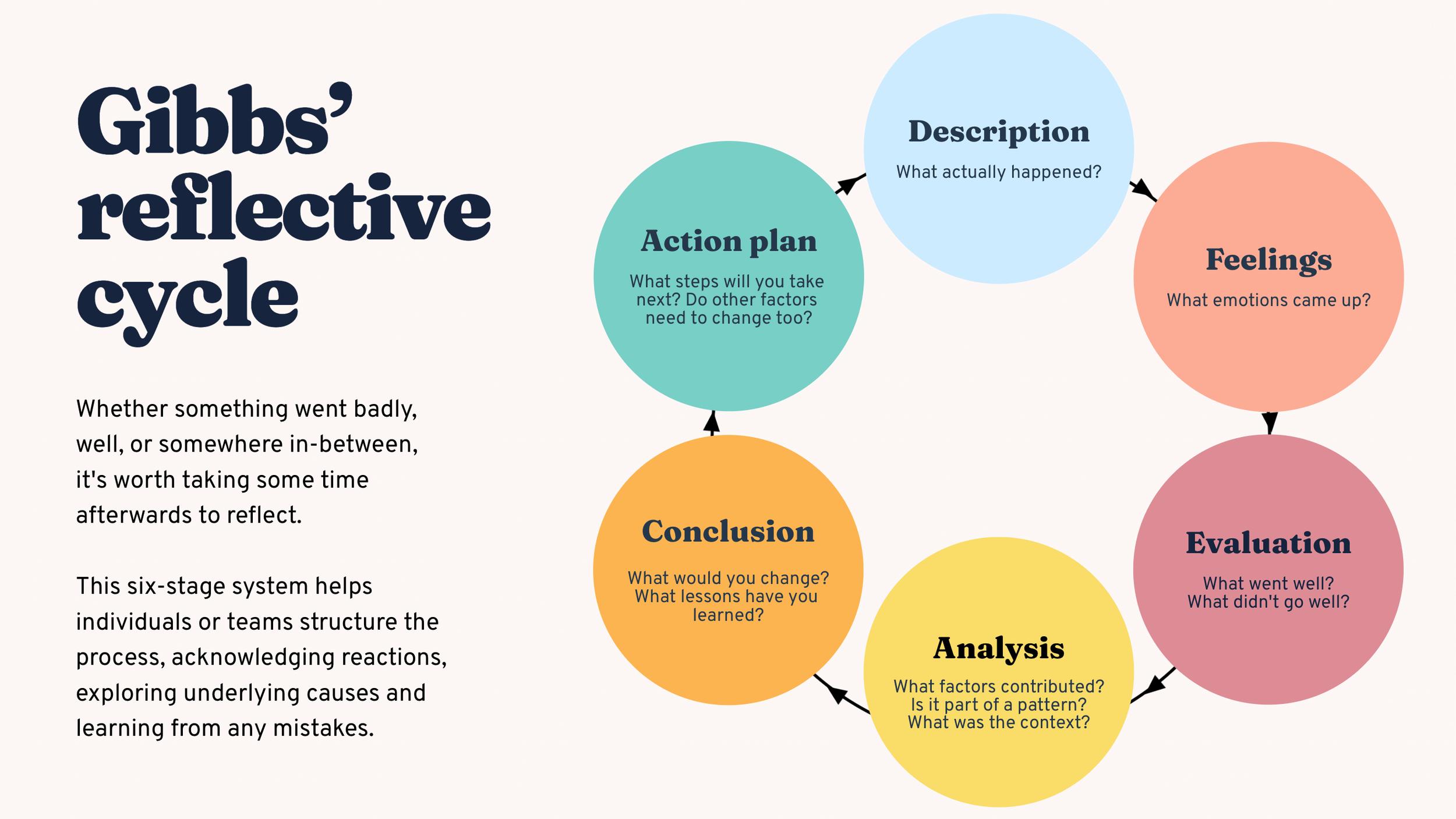
Gibbs' Reflective Cycle is widely used in nursing, education, and social work. It provides six stages:
-
Description: Explain what happened and provide relevant background.
-
Feelings: Examine thoughts and emotions experienced during the event.
-
Evaluation: Identify what went well and what could have been improved.
-
Analysis: Explore why the event occurred and connect it to relevant knowledge.
-
Conclusion: Explain what was learned from the experience.
-
Action Plan: Identify what could be done differently in a similar situation.
This model is particularly useful for students who need a clear structure for analyzing practical experiences.
Kolb's Experiential Learning Cycle
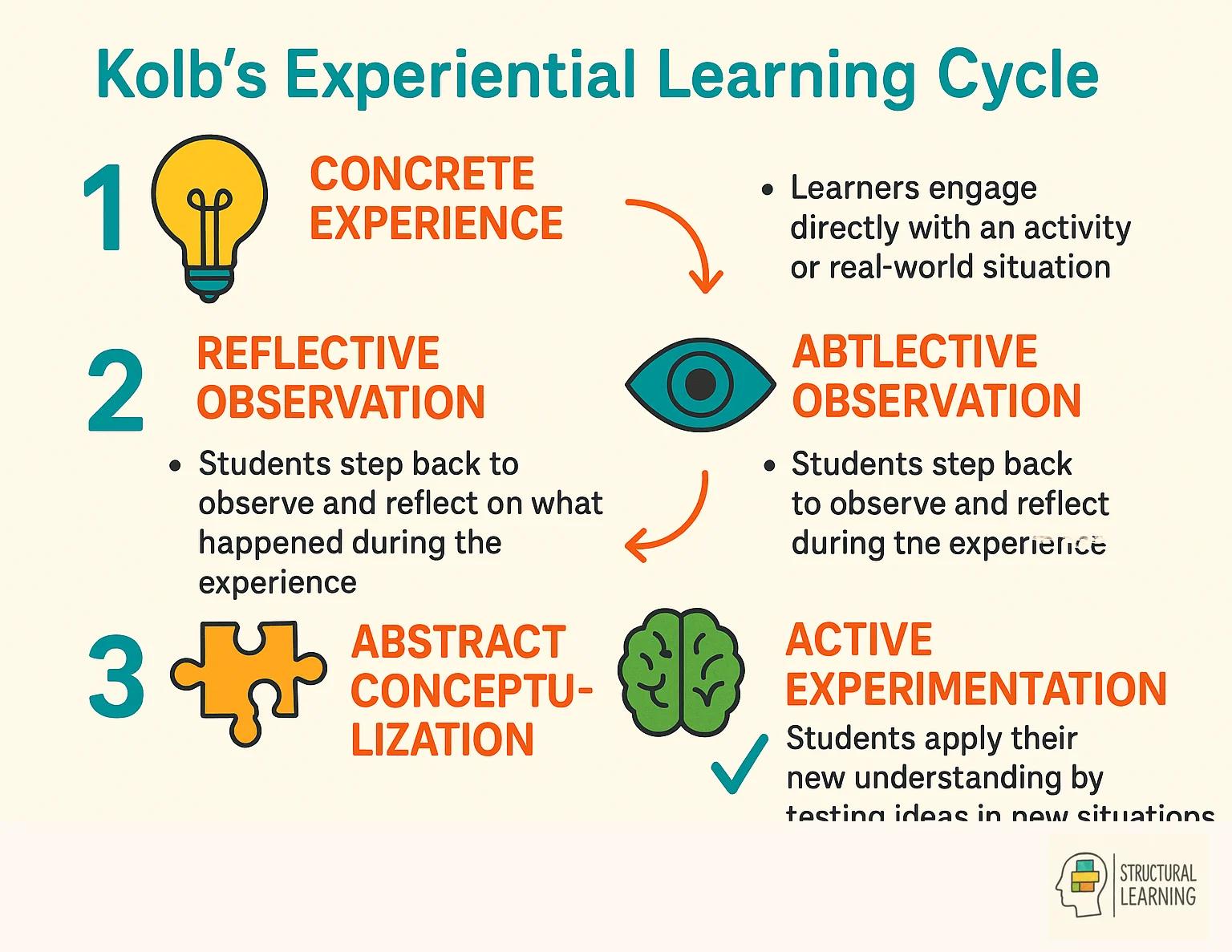
Kolb's model explains how individuals learn through experience and reflection. It consists of four stages:
-
Concrete Experience: Participating in an activity or experiencing an event.
-
Reflective Observation: Reviewing and considering the experience.
-
Abstract Conceptualization: Developing new ideas or understanding from the experience.
-
Active Experimentation: Applying the new knowledge in future situations.
Students can use this framework to explain how practical experiences contribute to learning and professional development.
Schön's Reflective Practice
Schön's approach distinguishes between two forms of reflection:
-
Reflection-in-action: Thinking and adjusting decisions while an activity is taking place.
-
Reflection-on-action: Reviewing an experience after it has occurred to understand what happened and how future performance could improve.
This approach is particularly relevant to professional disciplines involving practical decision-making, including nursing, teaching, and social work.
What Makes a Good Reflective Journal?
A successful reflective journal should demonstrate meaningful analysis rather than simply provide a chronological account of events. Several elements contribute to a strong submission.
Clear description of the experience: The reader should understand the situation, the people involved, and the circumstances surrounding the event.
Personal insight: Students should explain their thoughts, feelings, assumptions, and reactions honestly and appropriately.
Critical analysis: The reflection should examine the reasons behind events, consider alternative perspectives, and evaluate the consequences of decisions.
Connection to academic theory: Relevant academic sources, professional guidelines, and established concepts should support the analysis where required.
Lessons learned: A reflective journal should explain how the experience influenced the student's understanding, skills, or professional development.
Future action: Students should identify realistic steps they can take to improve their knowledge or performance.
How Our Reflective Journal Writing Assistance Works
At Prime-Essays.com, students can explore academic support for different types of reflective assignments. The process is designed to help students understand their requirements and develop well-organized reflective work.
Step 1: Share Your Assignment Instructions
Provide the assignment brief, marking rubric, required reflective model, word count, and referencing guidelines. These details help establish the expectations of your university.
Step 2: Provide Relevant Experience or Notes
Reflective journals are based on personal learning and experiences. Share your own observations, notes, or experience summary so that the reflection accurately represents your perspective.
Step 3: Develop a Suitable Structure
Organize the assignment around the required reflective framework. This may include Gibbs' Reflective Cycle, Kolb's Learning Cycle, or another model specified by your instructor.
Step 4: Develop the Critical Analysis
Examine what happened, why it happened, what you learned, and how academic concepts relate to the experience. Identify areas of strength and opportunities for improvement.
Step 5: Review and Improve the Writing
Check grammar, clarity, academic tone, paragraph organization, referencing, and compliance with the assignment instructions.
Common Mistakes to Avoid in Reflective Journal Writing
Even students with strong writing skills can make mistakes when preparing reflective assignments. Understanding these common problems can improve the quality of the final submission.
-
Only describing events: A reflective journal should explain the significance of an experience rather than simply narrate what happened.
-
Ignoring personal learning: Students should clearly identify how their understanding or skills changed.
-
Failing to use academic sources: Where required, reflections should connect personal experiences to relevant theories and scholarly evidence.
-
Using an inappropriate reflective model: Always follow the framework specified in the assignment instructions.
-
Avoiding critical evaluation: Effective reflection considers challenges, mistakes, alternative approaches, and lessons learned.
-
Ignoring future development: Include practical steps for improving future performance.
-
Overlooking referencing requirements: Cite academic sources correctly using the required style, such as APA, Harvard, or MLA.
Benefits of Professional Reflective Journal Assistance
Working with academic writing support can help students approach reflective assignments more confidently. Some important benefits include:
-
Better organization: Develop a clear structure that follows the assignment requirements.
-
Stronger critical thinking: Learn how to analyze experiences and evaluate different perspectives.
-
Improved academic expression: Strengthen grammar, clarity, sentence construction, and academic tone.
-
Effective use of reflective models: Understand how established frameworks can guide personal reflection.
-
Appropriate academic referencing: Learn how to integrate scholarly sources and professional guidelines.
-
Improved self-awareness: Identify learning outcomes, professional strengths, and areas requiring development.
The objective of reflective writing support should be to help students develop their own understanding and communicate their experiences effectively.
Why Choose Prime-Essays.com for Reflective Journal Writing Support?
Reflective assignments often require a combination of personal insight, academic knowledge, and structured analysis. Prime-Essays.com offers academic writing assistance for students who need guidance with reflective journals and related assignments.
Students can explore support with:
-
Nursing and clinical placement reflections.
-
Social work reflective journals.
-
Teaching practice reflections.
-
Psychology and behavioral studies reflections.
-
Business and management reflections.
-
Gibbs' Reflective Cycle assignments.
-
Kolb's Experiential Learning Cycle.
-
Academic editing, proofreading, and referencing.
Whether you are preparing a short weekly reflection or a detailed professional development journal, it is important to understand your assignment requirements and ensure that the final work accurately reflects your own experiences and learning.
Frequently Asked Questions About Reflective Journal Writing
1. What is a reflective journal writing service?
A reflective journal writing service provides academic assistance with planning, structuring, analyzing, editing, and improving reflective assignments. It can help students understand reflective models and communicate their personal learning experiences effectively.
2. How do I start writing a reflective journal?
Begin by identifying an experience relevant to your assignment. Describe the situation, explain your reactions, evaluate what happened, connect the experience to relevant academic concepts, and identify lessons for future improvement.
3. Which reflective model is best for academic assignments?
Gibbs' Reflective Cycle is useful for structured reflection because it provides six stages of analysis. Kolb's model is suitable for examining experiential learning, while Schön's approach focuses on reflection during and after professional activities. The best choice depends on your assignment instructions.
4. Can I use academic references in a reflective journal?
Yes. Many academic reflective assignments require students to support their analysis with scholarly sources, professional standards, and relevant theories. However, the exact referencing requirements depend on the course and assignment guidelines.
5. What subjects require reflective journal writing?
Reflective journals are common in nursing, healthcare, social work, education, psychology, business, management, and other professional disciplines.
6. How is a reflective journal different from a traditional essay?
A traditional essay generally focuses on presenting and supporting an argument. A reflective journal examines personal experiences, learning, reactions, and professional development while connecting them to relevant academic knowledge.
7. Can I get help editing my reflective journal?
Yes. Academic editing and proofreading can help improve grammar, clarity, organization, referencing, and academic expression while preserving your personal voice and experiences.
Conclusion: Get Support with Your Reflective Journal
Reflective journal writing is an essential part of academic and professional development. It encourages students to evaluate experiences, recognize their strengths, identify areas for improvement, and apply theoretical knowledge to practical situations.
A reliable reflective journal writing service can help students understand reflective frameworks, organize their observations, strengthen critical analysis, and improve the presentation of their assignments. At Prime-Essays.com, students can explore academic guidance, editing, proofreading, and writing support for reflective journals across different disciplines.
Whether you are working on a nursing reflection, social work journal, teaching practice assignment, or business reflection, developing a clear and thoughtful approach can make your academic work more meaningful.